

Insulation for extreme loads
EXTRUDED POLYSTYRENE
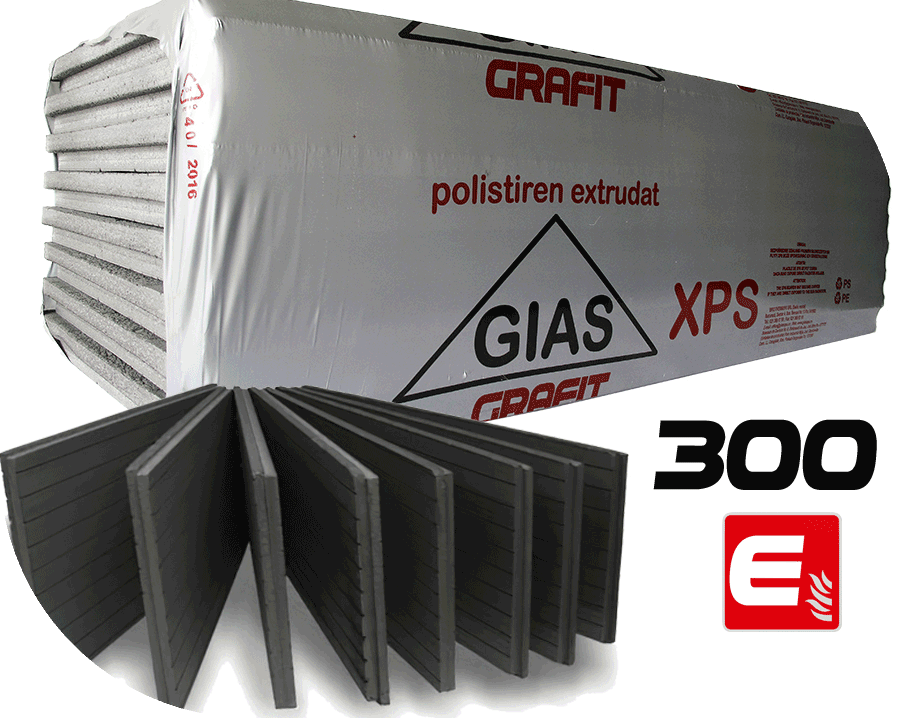
GIAS XPS 300 E
PRODUCT DESCRIPTION
GIAS XPS 300E It is a high-density extruded polystyrene board designed to provide excellent thermal insulation and superior mechanical strength in various applications: facades, terraces, plinths, and high-load floors. Due to its closed-cell structure, the material does not absorb water, does not deform, and maintains its performance even in extreme conditions of moisture or freeze-thaw cycles.
The GIAS XPS 300E boards offer constant dimensional stability and lasting mechanical performance. The profiled edges ("Tongue and Groove") facilitate a fast and precise installation, creating a tight joint that significantly reduces thermal bridges. The product is ideal for both new constructions and renovations, standing out due to the excellent ratio between low weight, superior rigidity, and long-term durability.
TYPICAL AREAS OF APPLICATION
- Thermal insulation of facades (in plinth areas).
- Floors and concrete slabs (residential and medium traffic).
- Thermal insulation of pitched roofs and non-trafficable flat roofs.
- Perimeter thermal insulation of foundations and basement walls.
KEY BENEFITS
-
Maximum Thermal Efficiency: Due to the very low thermal conductivity value λD = 0.028-0.034W/(m·K), the product ensures exceptional insulation and significantly reduces long-term energy costs.
-
Impermeabilitate Absolută: Structura celulară închisă, etanșă și absorbția extrem de redusă a apei (<7%) fac produsul ideal pentru medii umede și aplicații subterane (fundații, socluri, terase inversate).
-
Stabilitate și Rezistență: Cu o rezistență la compresiune de ≥ 300 kPa, placa poate suporta sarcini moderate spre mari, fiind potrivită pentru pardoseli și terase circulabile rezidențiale.
-
Durabilitate Garantată: Durata de viață estimată de peste 50 de ani asigură că investiția în izolație rămâne eficientă și stabilă pe termen foarte lung.
-
Versatilitate în Aplicare: Produsul este potrivit pentru o gamă largă de aplicații (fațade, sub șapă, acoperișuri), adaptându-se cerințelor de siguranță la foc (Clasa E)
SPECIFICATIONS
| Feature | Value / Unit | Standard |
|---|---|---|
| Reaction to fire | Euroclasa E | EN 13501-1 |
| Compressive strength (10%) | ≥ 300 kPa | EN 826 |
| Thermal conductivity (λD) | 0.028-0.034 W/mK | EN 12667 |
| Water absorption (long-term) | ≤ 0.7% | EN 12087 |
| Dimensional stability | ≤ 5% | EN 1604 |
DATA SHEET
EXTRUDED POLYSTYRENE GIAS XPS 300E
GIAS XPS 300 E 40-50 mm

GIAS XPS 300 E 60-100 mm
GIAS XPS 300 E 120-160 mm
Briotherm
GIAS XPS
Get in touch for guidance on how to use our products or if you have any questions about our products;
International Contacts
Where to find us
Briotherm
GIAS XPS
Get in touch for guidance on how to use our products or if you have any questions about our products;
International Contacts
Where to find us

Social Media
Get in touch
We would like to hear any questions you may have, and we are open to communication using our social media channels.
Copyright by GIAS XPS. All rights reserved 2026
Copyright by GIAS XPS. All rights reserved 2022
 English
  Romanian
  Italian
  Hungarian
  French
  German
  Polish
  Bulgarian
  Serbian
  Croatian